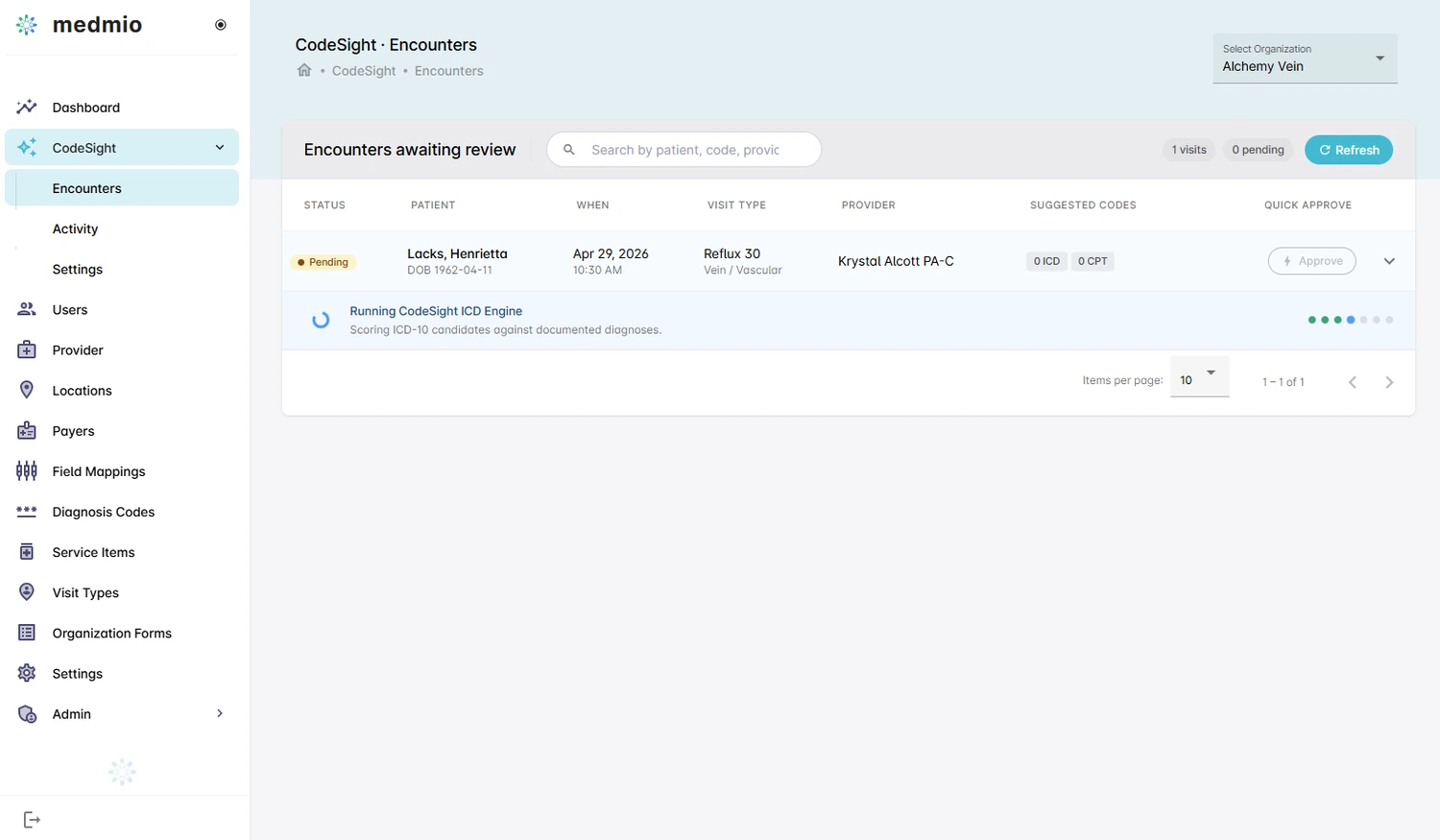
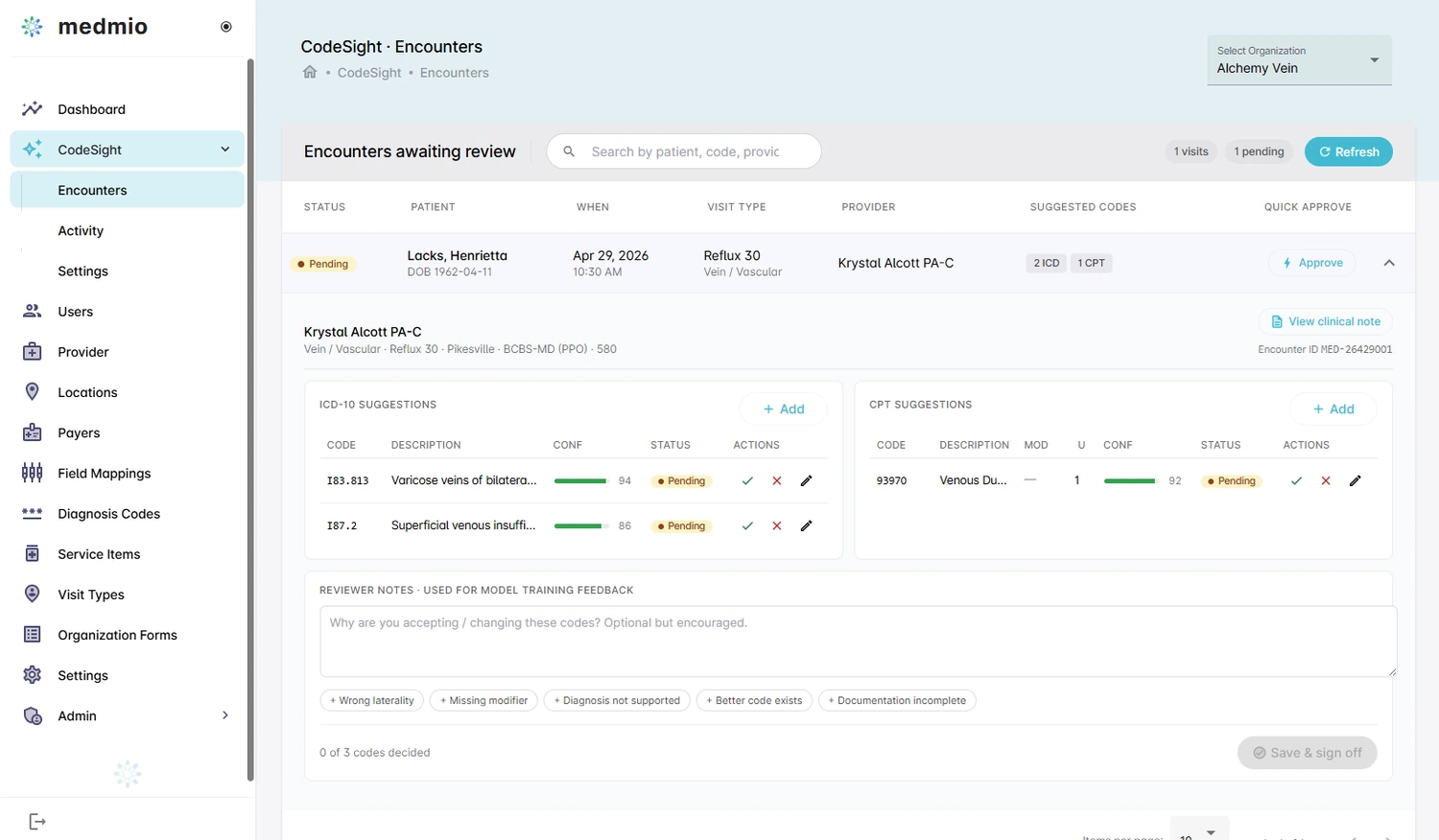
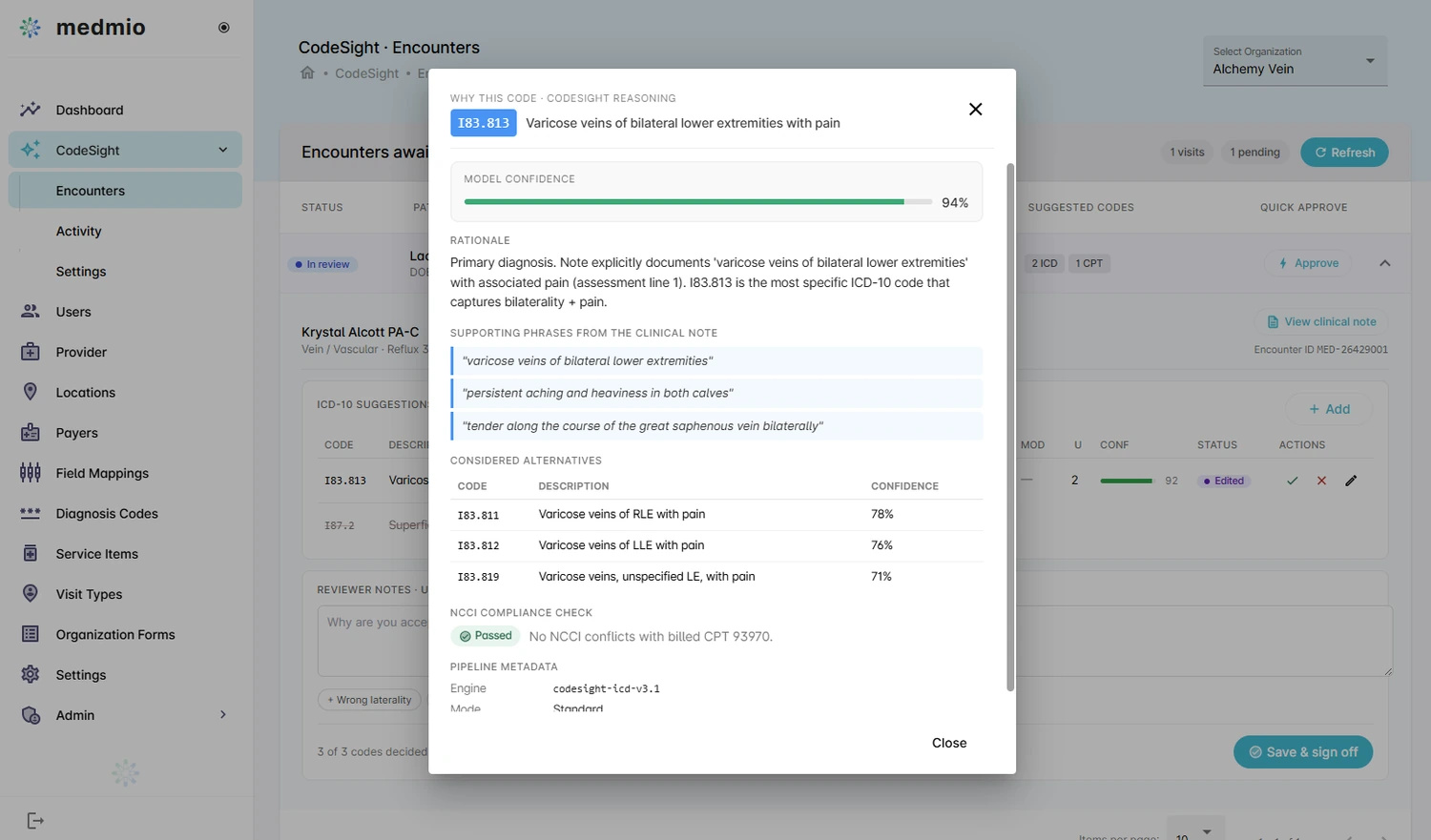
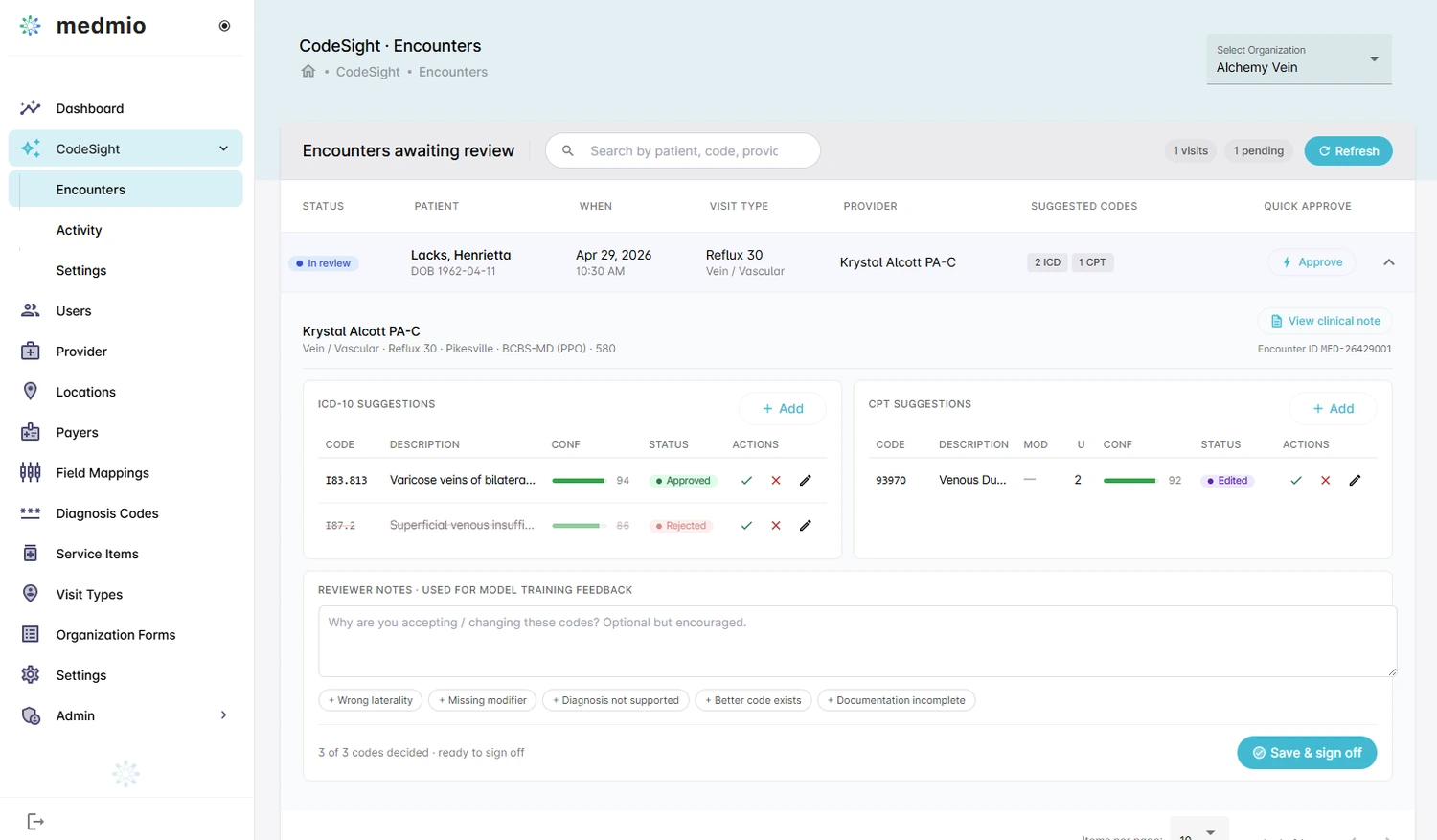
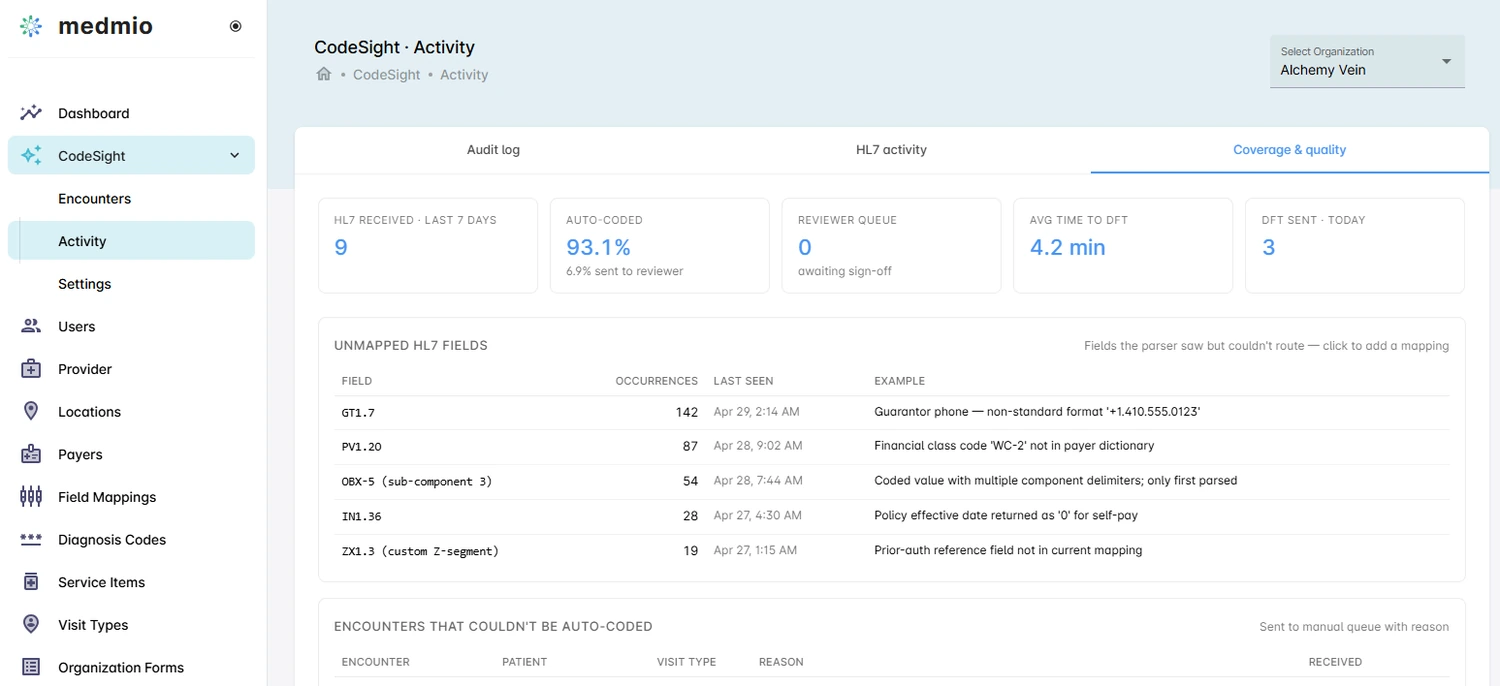
An encounter arrives from the EHR — CodeSight™ scores ICD-10 and CPT candidates against the documented note.
Multi-site vascular practice · 92,400 encounters · 12 months · no EHR migration. Read the case study →
Six models. One verdict.
A six-stage orchestration of ML models and frontier LLMs — reading the note, checking payer rules, and routing by confidence at the point of care.
Why practices switch to AI medical coding
Recover Lost Revenue
Clinically defensible codes mean fewer denials. Correct modifiers prevent underpayment. Automated charge capture eliminates missed charges.
Reduce Charge Lag
Real-time HL7 triggers eliminate queuing time. Codes assigned in seconds, not days. Charges hit the billing queue immediately after visit close.
Lower Audit Risk
Confidence scoring creates audit trails. Every code is defensible. Payer rules prevent coding errors that trigger audits.
Watch: AI medical coding, explained
Conceptual overview — for an actual product walkthrough, start a free pilot.

Hosted on YouTube. Click to play — no autoplay.
Frequently Asked Questions
Accuracy varies by specialty and clinical complexity, but CodeSightTM’s ensemble approach consistently outperforms single-model solutions and outperforms manual human coders in both speed and accuracy. We provide confidence scores so you can review low-confidence codes before billing.
CodeSightTM integrates via HL7v2 and FHIR REST APIs, which are supported by virtually all modern EHRs. We have pre-built integrations for Athenahealth, eClinicalWorks, Epic, Cerner, and others. Contact us for a compatibility check with your specific EHR.
Implementation typically takes 2-6 weeks from contract to production, depending on your EHR and integration complexity. We handle all HL7 mapping, testing, and staff training. Your team stays involved throughout, and we provide 24/7 support during go-live.
Yes. CodeSightTM is HIPAA-compliant and meets HITECH requirements. All data is encrypted in transit (TLS 1.2+) and at rest (256-bit AES). We undergo regular security audits and penetration testing. Data is processed in AWS with BAA in place. We never use your data for model training.
Yes. You control the confidence threshold for auto-billing. Codes below your threshold are flagged for manual review before posting. Most practices set thresholds at 95%+, but you can adjust based on your risk tolerance and audit history.
CodeSightTM's coding accuracy and payer rules dramatically reduce denials. When denials do occur, our RCM Analytics module tracks denial codes and reasons, helping you spot systemic issues (like bundling violations or missing modifiers) for quick remediation.
No — it augments them. CodeSightTM auto-codes the routine, high-confidence encounters and routes anything below your confidence threshold to a human-review queue. Your coders shift from coding every chart by hand to reviewing exceptions, handling complex cases, and QA — clearing far more volume with fewer errors.
Most EHR suggestions and traditional computer-assisted coding (CAC) surface candidate codes from keyword rules and leave a coder to decide. CodeSightTM is autonomous AI medical coding: an ensemble of ML models and frontier LLMs reads the full note, applies payer and NCCI rules, and assigns ICD-10, CPT, and modifiers with a confidence score — escalating only the uncertain ones, so most encounters need no manual touch.